

At the University of Irvine, US, researchers have discovered a new packing material – that is stretchable and eco-friendly. The package could, in the future, be used to regulate heat through reconfigurable metal structures and used to protect a variety of products.
The research was published in Nature Sustainability and seeks to provide a sustainable alternative to metalized polymer films that are used in packaging.
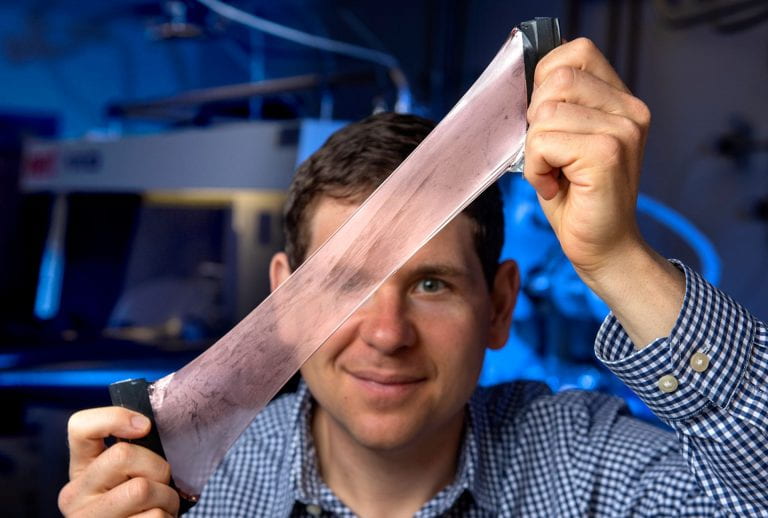
Sustainable and Squid-Inspired
The new packaging offers a way to control how hot or cold to keep the stuff it encases by using minimal energy. So, in such cases, if you’re holding a hot coffee cup, the material will keep your hands while keeping the drink hot.
“There is an enormous array of applications for this material,” said University of California, Irvine chemical and biomolecular engineering professor Alon Gorodetsky in a press release. “Think of all the perishable goods that have been delivered to people’s homes during the pandemic. Any package that Amazon or another company sends that needs to be temperature-controlled can use a lining made from our squid-inspired adaptive composite material.”
Gorodetsky revealed that he and colleagues were inspired by the common squid. A squid’s skin is embedded with organs called chromatophores, which it expands and contracts to change its appearance. The team mimicked the cephalopod skins of creatures like squid, octopus, and cuttlefish to create the composite material.
“The metal islands in our composite material are next to one another when the material is relaxed and become separated when the material is stretched, allowing for control of the reflection and transmission of infrared light or heat dissipation,” said Gorodetsky. “The mechanism is analogous to chromatophore expansion and contraction in a squid’s skin, which alters the reflection and transmission of visible light.” He shared that chromatophore size changes help squids communicate and camouflage their bodies. The team mimicked this approach while creating the composite material that enables tunable thermoregulation – which is key to energy efficiency and protecting one’s hands from high temperatures.
The newly-developed composite material can be used to control temperatures for everything from coffee mugs to tents to large containers.
The key breakthrough of this project was the researchers’ ability to develop the composite material using cost-effective methods. According to the study, the copper and rubber materials used hardly cost a dime per square meter and the cost will be further reduced when bought in bulk.
The eco-friendly material can be used in a variety of applications, said lead author Mohsin Badshah, a former UCI postdoctoral scholar in chemical and biomolecular engineering. “The composite material can be recycled in bulk by removing the copper with vinegar and using established commercial methods to repurpose the remaining stretchable polymer,” he said.
At the UCI campus, the team conducted multiple tests and proved that they could control the cooling of the coffee.
An excited Gorodetsky talked of a future wherein perishable goods can have a lining made out of the squid-inspired composite material. This will reduce costs and help e-commerce companies like Amazon that need to send temperature-controlled substances.
Last year, amazon was criticized for using frozen plastic bottles to control temperatures of food. Greenpeace accused it of greenwashing the world as more plastic just meant more pollution. In recent times, many industries have been accused of greenwashing as they struggle to balance sustainability efforts with profit-making. A cheap alternative like this composite material, would be a good option for large companies looking to meet their environmental goals. However, research has revealed that although it seems expensive in the short term, sustainable practices boost economic growth and help save the planet. According to research by Deutsche Bank, which evaluated 56 academic studies, companies with high ratings for environmental, social, and governance (ESG) factors have a lower cost of debt and equity and outperform market competition in the long-term.


