Tadashi Yanai, founder of clothing retailer Uniqlo and Japan’s richest person with a net worth of $47.1 billion, turned his family’s small store into a global fashion empire. Uniqlo’s parent company Fast Retailing, which he also built, now has a market capitalization of 16.09 trillion yen (US$106 billion) and rakes in trillions of yen in annual sales. For Yanai, the complexities of retail were innate even as a young boy – deeply ingrained learnings from a childhood spent working in the men’s clothing store owned by his father in the small town of Ube.
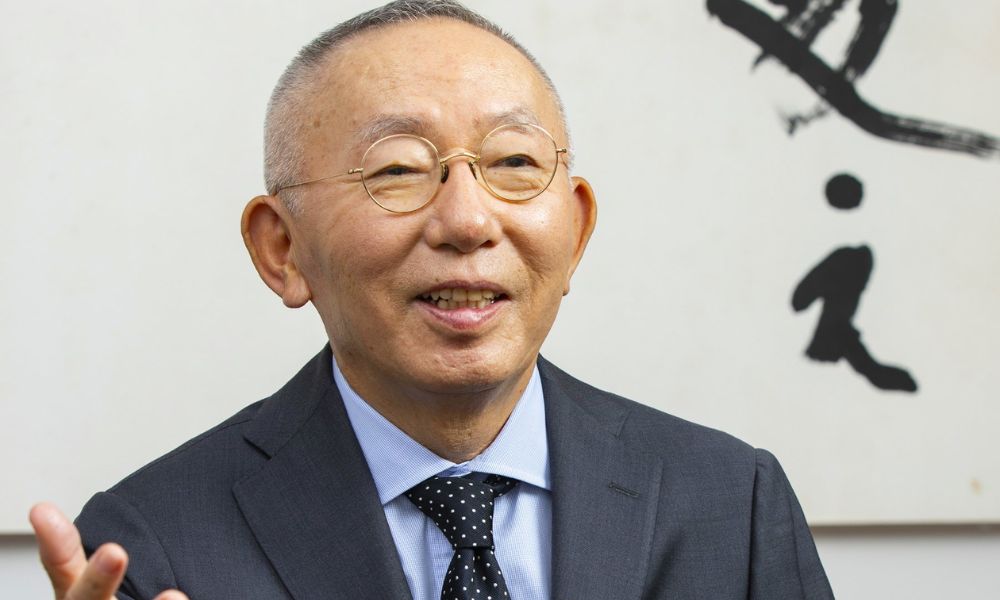
The massive fortune, which placed him at the top of Forbes’ Japan rich list, surpassed what Yanai, 74, could have anticipated when he started out in the 1970s.
Tadashi Yanai’s philosophy for Uniqlo
Japan’s richest person, the Founder and CEO of fashion giant Uniqlo, Tadashi Yanai, has just two outfits in regular rotation, a $15 navy-blue Merino-wool crew-neck jumper and a +J blue suit from Uniqlo’s collaboration with German designer Jil Sander.
His commitment to these unassuming ensembles may seem at odds with the man behind one of the world’s most successful fashion houses, however, upon closer inspection, these inherently Japanese principles of “practical beauty” and “simple made better” ultimately underscore his company’s entire philosophy.
You might not be able to pick out his designs in a crowd, but that’s part of Uniqlo’s appeal – to provide chic, timeless, high-quality basics that can be worn year in, year out, blending seamlessly with the rest of your wardrobe.
For Yanai, the complexities of retail were innate even as a young boy – deeply ingrained learnings from a childhood spent working in the men’s clothing store owned by his father in the small town of Ube.
Yanai’s early influences and entrepreneurial roots
For Yanai success did not come easy, it has not been all smooth sailing, as both he and his company have endured their fair share of failures.
Yanai was born in 1949 in southern Japan, where his father was a tailor and his mother was a housewife. His father opened a men’s clothing store a month after his birth, called Men’s Shop Ogori Shoji, in the town of Ube, Yamaguchi Prefecture. The store occupied the ground floor of the house his family lived in at the time, and later expanded with multiple locations in the next two decades.
Yanai graduated from the esteemed Waseda University in 1971 with a degree in economics and politics. After a year selling kitchenware and men’s clothing at a Jusco, now AEON supermarket, he joined his father’s business.
Within two years, most of the staff had left due to tensions with his management style, which he later admitted was arrogant in an earlier interview.
Due to the lack of staff, he had to handle most tasks at the store. For Yanai him this was a crash course in business.
The name Uniqlo
By 1984, Yanai had taken the reins as CEO. He established the first branch of the Unique Clothing Warehouse in Hiroshima. He had big ideas and an even bigger plan for fashion world domination. Unique Clothing Warehouse was later shortened to Uniqlo.
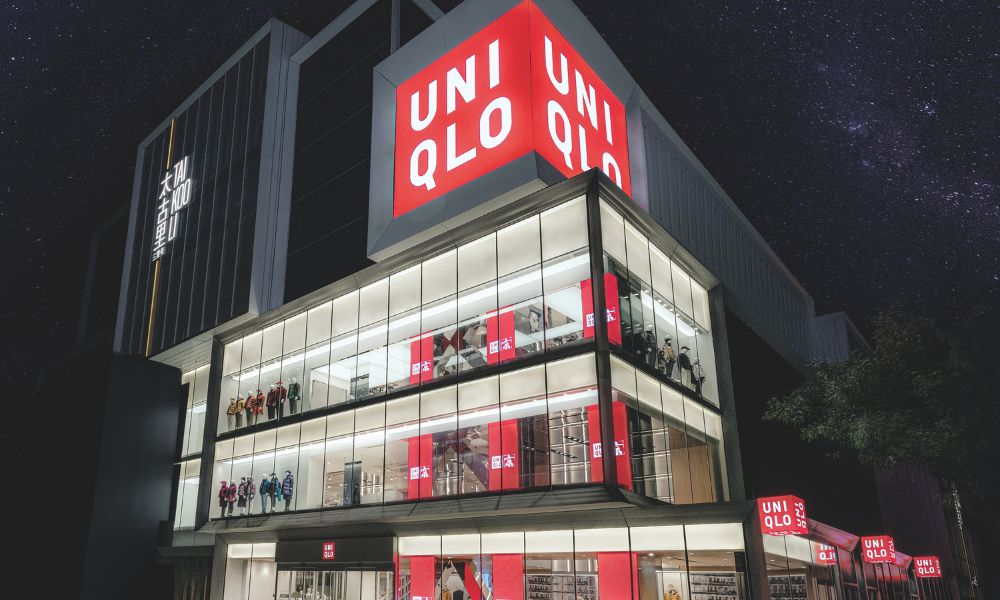
It was originally meant to be registered as Uniclo, but the staff at the time misread the “c” as a “q,” leading to the current spelling of Uniqlo, the New York Post reported, citing a statement from the brand.
In 1991, Yanai renamed his father’s business name from Ogori Shoji to the more globally identifiable Fast Retailing, a nod to the fast-food prototype.
Uniqlo’s turning point
Inspired by European and American brands such as Benetton, Gap and Esprit that he’d seen during his travels, Yanai set to work, transplanting the model of mass-made casual apparel chains into Japan. He grew the company to over 100 stores within three years. By 1996, the store count had doubled.
The firm’s turning point came in 1998 with the opening of its first store in Tokyo. The launch introduced a fleece jacket priced at just $15, appealing to budget-conscious consumers in the post-bubble economy.
Around one in four Japanese purchased a fleece item from Uniqlo that year, with the chain selling 26 million fleece products across more than 400 stores in 2000.
Uniqlo’s focus on innovation
By 1998, Uniqlo had more than 300 stores across Japan, and their infamous fleece jacket had sold two million units in just 12 months. Business was booming and, for all intents and purposes, Uniqlo was kicking profit goals and gaining notoriety across Japan.
However, in spite of its popularity, the brand had gained the unflattering reputation of “cheap and shoddy”. Determined to turn things around, Yanai embarked on a mission for transformation of Uniqlo.
In 2004, the company announced its Global Quality Declaration, a pledge to stop making low-priced, low-quality garments. “I want to be valued for offering good clothes,” Yanai said at the time. “To be known for being cheap is sad.”
Innovation was heralded as Uniqlo’s new number one priority. Cashmere was added to their regular offering, as were thermal garments made from a new internally developed fabric named HeatTech.
Uniqlo global rise
Following its success in Japan, Uniqlo ventured abroad, launching its first international store in London in 2001.
But by 2004, the chain had to close most of its stores in the city and faced a similar challenge in Shanghai, China. It launched its first three U.S. stores in New Jersey in 2005, but all were closed within a year.
The firm eventually returned to Europe with great success, opening flagship stores in London and Paris in 2007.
The difference this time, according to Yanai, was that it worked with its global headquarters to create products that not only meet local demands but also have global appeal.
Yanai’s business strategy for Uniqlo’s success
Uniqlo’s success can be attributed to its focus on innovation, having spent years investing in developing materials that meet consumer needs, according to Forbes.
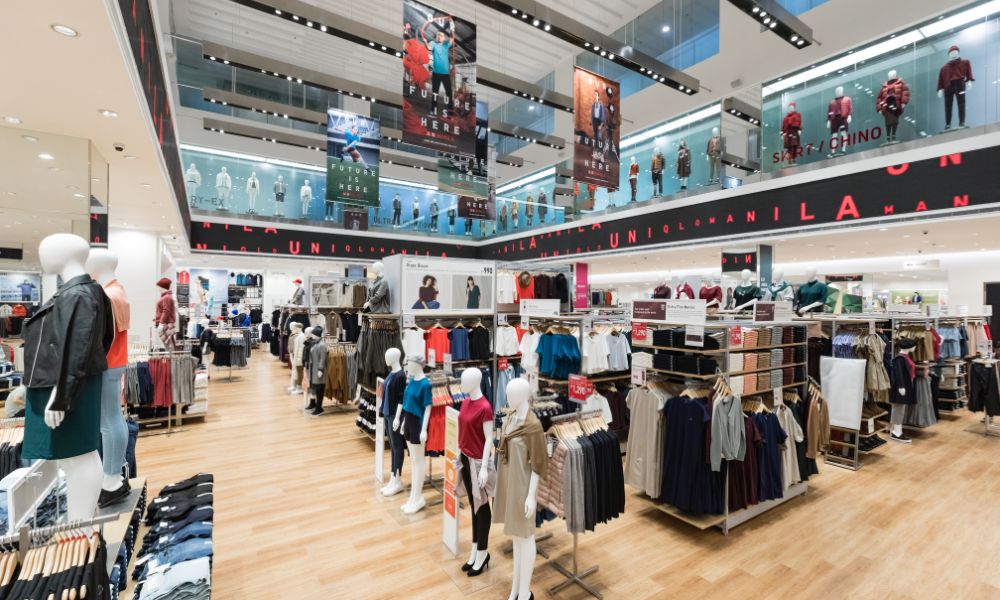
While its competitors race to release new styles to chase trends, Uniqlo has built its reputation by creating wardrobe essentials that emphasize daily functionality and durability. As consumers increasingly prioritized sustainability and longevity, this approach proved to be highly successful, this approach proved successful.
Yanai transformed his family’s modest clothing store into a global fashion empire that now has nearly 3,600 locations worldwide.
In the 2024 fiscal year ending in August, Fast Retailing reported 3.1 trillion yen in sales and 500.9 billion yen in operating profit. This marks the first year that its sales surpassed 3 trillion yen and its operating profit exceeded 500 billion yen.
Throughout the company’s meteoric rise, Yanai has remained steadfast in his commitment to innovation and quality.
Uniqlo’s CEO Yanai’s leadership played an important part in growth of the company. To this day, he still maintains the drive he had when he launched the business in 1984, according to Yukihiro Katsuta, Fast Retailing’s group senior executive officer, who has been working with Yanai for 19 years.
Awards for Uniqlo
Uniqlo was awarded Retailer of the Year by the World Retail Congress in 2014, while Yanai was named as one of the 100 most influential people in the world by Time magazine in 2013 and one of the 100 greatest entrepreneurial minds by Forbes in 2017.
While he’s been alluding to possible retirement for nearly a decade now, Yanai shows no signs of slowing down anytime soon. “I believe that the founder of a company never truly retires, and my passion for business remains as strong as ever,” he said in a statement released in March.
He is also pragmatic about his success.
“I might look successful, but I’ve made many mistakes,” Yanai told Monocle. “People take their failures too seriously.” During his decades in the industry, the entrepreneur has discovered that above all else, businesses need to be adaptable – keeping in mind not just the unpredictable flux of fashion, but also the frenetically evolving society we live in.
Due to Covid like the rest of the industry, Uniqlo took a hit, closing half of its 748 stores in China after lockdowns were enforced in January, and 40% of its Japan stores in May.
All have since reopened and, rather surprisingly, Fast Retailing’s shares were up 53% in July since 19 March, and these look set to continue rising. Now, as other brands scramble to make up for lost revenue, Uniqlo has remarkably managed to come out on top once again – like a puffer-jacket-clad phoenix rising from the ashes.
Dairo Murata, senior analyst at JP Morgan in Tokyo, believes its immunity to the long-term effects of the pandemic is thanks in part to the fact that “it’s a supplier of ordinary life clothing and rooted in real demand”.
Uniqlo a technology company
Indeed, Uniqlo has always been dictated by product developments, rather than trends. It’s also undoubtedly a result of Uniqlo’s enduring quest for innovation. Yanai has long voiced his opinion that Uniqlo is “not a fashion company, (but) a technology company”.
And given their tech-style approach to both research and operations, it’s hard not to agree. In June, they launched AIRism, a range of facemasks that flew off the shelves. And as it looks increasingly likely that working from home will continue long into the future, Uniqlo’s luxe loungewear and cosy separates are remaining high on customers’ lust lists.
Yanai’s unwavering determination, drive and grit have propelled his company through myriad challenges, global recessions, the initial failures of opening international stores, and now, a pandemic.
And each time, rather than conceding defeat, he has battened down the hatches to weather the storm, ready to find new solutions and always emerging ready to take on the next chapter.
“The world is constantly changing,” he told The Star in 2010. “To succeed in this environment, you need to make mistakes, fail, learn from them and move on.”
Tadashi Yanai’s life other than work
Tadashi Yanai usually comes back home after work by 4 p.m. to play some golf and spend time with his wife.
Japan’s richest person is reportedly an avid golfer and owns two golf courses in Hawaii. This is where he typically spends a few weeks playing each summer. Yanai reportedly bought the first, Plantation Golf Course, for $50 million in 2009, and the second, Kapalua Bay, for $24.1 million in 2010.
He has two sons who are both on Fast Retailing’s board of directors.
Tadashi Yanai’s ambition for Uniqlo
A man of ambition, Tadashi Yanai has made it clear he wants his firm to be the world’s largest clothing retailer.
Fast Retailing projected that its operating profit will increase to 530 billion yen in fiscal 2025.
As the brand completes 40 years, Yanai has announced his next big vision—“The Fourth Frontier: Challenge, Take Action, Achieve.” This illustrates the changes that Uniqlo will undergo in order to become a truly global brand.
The billionaire has set a target of achieving group revenue of ¥5 trillion within a few years, and then he says, “doubling that to ¥10 trillion is not an unrealistic goal”.
In the 2023 Integrated Annual Report, Yanai writes: ‘We will tackle the challenges of the future, driven by our mission: Changing clothes. Changing conventional wisdom. Change the world. Technology is advancing quickly and people’s clothing needs are evolving as well. We need to anticipate those needs… how clothing will evolve, innovate and produce those products,” says Yanai.
Following this year’s record revenue, he said the company is focused on dominating Western markets as it strives for annual sales exceeding 10 trillion yen, as reported.