Backpack across the cities of Europe, explore the boutique wineries of Santorini or even take a staycation in Manhattan for NY Fashion week.
With the world ready for your travel, if you miss out on booking an Airbnb lodging, you are losing out on one of the unique vacation rentals.
Airbnb. Inc is a vacation rental company that connects people looking for short homestays to people who wish to rent out their homes. It’s a lucrative way to earn some income from one’s property.
Though Airbnb is a success today, it was not always received well in its inception. So how did a startup become a business with a net worth of $61.4 billion spanning over 11 years? Here is a timeline of one of the most inspiring pioneers of the hospitality industry.
HOW AIRBNB SUCCESS STORY BEGAN

Airbnb success story began in 2007 when two roommates at Rhode School of Design had no means to pay the rent of their cozy loft in California.
Brian Chesky and Joe Gebbia figured they needed to make extra cash. An Industrial Designers’ Conference was set to take place in San Francisco.
When they noticed a shortage in existing hotel stays, they found their multi-million business concept: to accommodate people by renting out their homes with air beds and assurance of homemade breakfast priced at $80 a night.
They created their website, airbedandbreakfast.com and attracted their first three guests, a man from Utah, another from India and a woman from Boston, by becoming tour guides.
Airbnb, circa March 2008 pic.twitter.com/xfIWzSqqT0
— Brian Chesky (@bchesky) November 24, 2022
The original website screenshot “AirBed&Breakfast.”
Gebbia and Chesky felt they had created a distinctive concept and invited their former roommate Nathan Blecharczyk to create a full-fledged business. They modified it into a platform that connected people looking for roommates until they came across another website implementing the same idea. So, they began building back on the original idea.
AIRBNB’S STRUGGLES AND REJECTIONS:
The trio tried their best to launch the venture with media attention at conventions and conferences, but a positive user response did not follow. They decided to get funding when they were knee-deep in debt trouble.
They tried it at SXSW too. They redesigned the website to make it easier for users to book in just 3 clicks. They set up meetings with fifteen angel investors but in vain.
They understood that their concept’s ‘bed’ angle wasn’t keenly received. So with the upcoming 2008 election, they handcrafted a limited edition of presidential-themed cereal boxes, which sold at $40: Obama-O’s, The Breakfast of Change and Cap’n McCains. This venture earned them $30000 and national media coverage.
Y Combinator founder Paul Graham invited them to his company. He was a venture capitalist, and his company could be described as a startup accelerator investing like Shark Tank.
Yet, they were rejected multiple times. Famous angel investor Fred Wilson rejected them and regrets it to date.
Our greatest weakness is giving up. A certain way to SUCCEED in life is always to try one more time.
Airbnb’s success journey continued because the founders did not give up. Instead, they kept recreating their website to make it more user-friendly.
In March 2009, they decided to shorten the name to Airbnb.
Furthermore, they went door to door to stay with the hosts, wrote reviews on their site and took professional pictures of the interiors and exteriors of the homes. High-definition photographs and improved profile pages were uploaded on Airbnb.com.
THE BREAKTHROUGH OF AIRBNB’S SUCCESS:
The fruit of hard work is always sweet. At the end of the YCombinator programme, the founders had built strong relationships with their customers. With seed funding of $20,000, they traveled to New York to base their target demographic community. With more exposure, within a month, they secured funding of $600,000 from Sequoia Capital.
After four years of hitting bumps, Airbnb was a huge success. In 2011, various Venture capitalists invested $112 million in the company, which transformed Airbnb’s valuation to $1 billion as a Unicorn startup in Silicon Valley.
In 2013, 7 million guests had booked on the website and mobile app of Airbnb.
FEW MORE OBSTACLES ALONG:
Many hosts complained of patrons leaving the house in an ‘unruly’ manner. For this, Airbnb implemented a new policy of coverage. “Host Guarantee” was at $1 million in 2012.
But, the problems were not over.
Various cities around the states started banning Airbnb. Restrictions like fining the host and not allowing a unit to be rented out for more than 30 days were placed.
Despite the setbacks, Airbnb did not stop its gradual rise. Studies also found that users did not wish to book hotels after booking Airbnb once.
In a Medium article published by Chesky, he explains the 7 times Airbnb got rejected and attached emails from different investors.
Next time you have an idea that gets rejected, I want you to think of these emails.
AIRBNB’S PROGRESS OVER THE YEARS:
Few of the marketing messages shared by Airbnb:
2007: Forget Hotels.
2008: Travel Like A Human.
2013: Belong Anywhere.
2016: Don’t Go There, Live There.
2021: Focus On The Real Experience.
In 2018, Airbnb had 34 offices globally, and the annual revenue was $3.6 billion. Few of the countries that found an impact on their economy with Airbnb were the United States, Canada, Italy, France, the United Kingdom and more. A report also suggested that patrons spent in their Airbnb’s neighborhood restaurants and cafes.
In the 2020 IPO process, the company was recorded to raise $25.9 million through rounds of funding, making their cash-in-hand $3.5 billion. In the same year, they entered into agreements with 400 local and national governments to automate tourism tax collection. The taxes were over $2 billion.
Due to the pandemic, Airbnb faced a drop of 67% in revenue and a staggering loss of $637 million. As a result, they were forced to lay off 1900 of their 7500 employees.
Over the years, Airbnb has acquired various companies like LocalMind, Accoleo, Luxury Retreats International and Tilt.com.
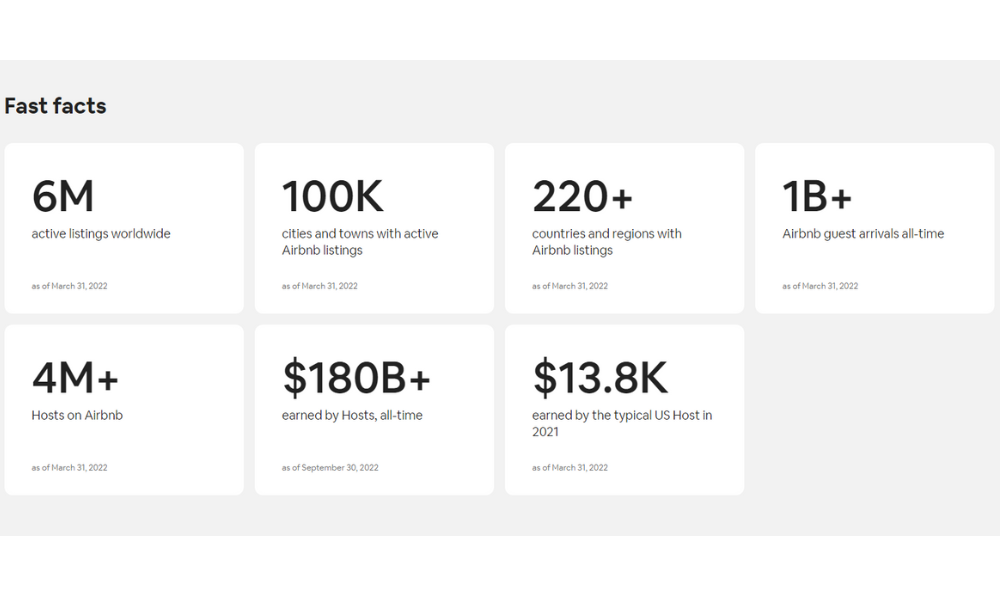
As of March 2022, Airbnb is in over 220+ countries with 4M+ hosts.
Starting today, my home is now on Airbnb (yes, this is my actual home and I’ll be there when guests are here)https://t.co/6XXFA7GNZ6 pic.twitter.com/xtKeJYIVrS
— Brian Chesky (@bchesky) November 17, 2022
PROS AND CONS OF BEING A HOST ON AIRBNB:
PROS
More Profitable than the Traditional Renting System
One can charge more on a nightly basis rather than renting it to a single long-term tenant.
Diverse Types of Tenants
If the long-term tenant is financially unstable, it may hamper the regular source of income. With Airbnb, multiple tenants are paying a substantially higher price.
CONS
Restrictions
In San Francisco, a host cannot rent out a part of the property unless it’s their primary residence. A 90-Day Airbnb Rule was introduced for the same. It is illegal to have more than 90 nights of non-hosted rentals where the host is absent.
High Expenses
Providing high-quality decor, appliances, food, Wi-Fi, and other amenities is essential for an Airbnb host. A long-term tenant does not expect the cleaning to be done by the landlord, but with an Airbnb home, the host is also responsible for cleanliness.
Gradual Success
An owner needs a reputation to receive more bookings, and the tenure of a guest is relatively short of deeming any proper review. So the success of an Airbnb host is gradual. And income is irregular.
WHAT CAN STARTUPS LEARN FROM AIRBNB SUCCESS STORY
- Finding solutions to existing problems at the right time can benefit the long run.
- Even with struggles, inspiring Airbnb’s Success is evidence that one must never give up on their dreams.
- Every founder needs to be creative to make their business lucrative.
- Think of unique ways to create funding for your startup.
- To deliver the best experience, one must work hard and diligently.
- Focus on the MVP of your product or service and make it user-friendly. Think of ways to scale up to flourish more.
- Even if people don’t believe in you, believe in yourself and your ideas.